The Odyssey and the Arcades
- Ralph Baer says he actually had the idea all the way back in 1951.
We have to take his word for it, though, because he didn’t actually do anything with the idea until a decade and a half later.
On the last day of August, during a business trip to New York, Baer waited at a bus stop for a colleague to show up. As the minutes passed by, his mind drifted to an idea, and he jotted down some quick notes in a small spiral notebook. - As soon as he got back to his office the next day, Baer expanded these notes into a full proposal for his employer.
The idea was to make a “game box,” sold at about $25, which would hook up to a regular television set and turn it into a display for all sorts of common games: “Action Games, Board Games, Sports Games, Chase Games and many others.”
This proposal had pretty much nothing to do with what they did as a company, but luckily, Baer had enough sway within the company to get the project started. It was only an experimental thing, a side project, but Baer was very secretive about it, keeping the door to the small room where the prototype was developed locked at all times. - It took less than a year to get a working prototype of “TV Game #1” up and running, with seven whole games working on the thing.
When presented to the board of directors, most were actually not particularly impressed. But nonetheless, they gave the go-ahead to develop the technology into something they could sell to a profit.
- A year or so later, the team turned the TV Game prototype into the Brown Box, named after its wood-grain casing. Besides a wide range of sports games, maze games, and quiz games, it had a big light gun peripheral to play shooting-based accuracy games as well.
Ralph Baer worked for a defense contractor; they had no stake in anything really related to television or games, and so they weren't prepared to manufacture the Brown Box themselves. Their plan was instead to patent the technology and license it out to an external company for them to produce, targeting television and electronics manufacturers.
A succession of representatives from these companies came to see the Brown Box in action, soliciting a range of reactions. Negotiations tended to be drawn out, lasting for months before falling through and moving on to the next suitor.Ralph Baer, Bill Rusch, Bill Harrison
- But as the TV Game market neared its debut, the arcade game market was experiencing something of a boom.
Although now more commonly associated with video arcade games, coin-operated attractions were an established field, with a separate history stretching back all the way to the 1800s. The mainstays were things like jukeboxes, slot machines, automated rocking horses, and games like pinball and pachinko. But while these were stagnant in Europe and North America, there was a rush of innovative, newer games coming from the emerging market in Japan. - It started with Masaya Nakamura, and his first game, Torpedo Launcher.
It was a shooting accuracy game, putting the player the position of a wartime submarine shooting enemy ships, represented by cardboard cutouts, using a light gun.
Masaya Nakamura, unknown others
- But when it was released as Periscope, the first arcade game out of the newly-formed Sega, it became much more popular.
Copies of Periscope were some of the first arcade games from companies like Midway and Taito, but it also secured Sega a position as the king of the arcades, putting out several similar shooting games in the years to come.
David Rosen, Shikanosuke Ochi, Hisashi Suzuki, unknown others
- Duck Hunt’s ducks moved around and disappeared when shot, and gave the player a higher score for headshots.
Hisashi Suzuki, unknown others
- Missile used a joystick with a fire button, one of the earliest examples of the control scheme.
Hisashi Suzuki, unknown others
- Gun Fight, themed around the Wild West, required the player to shoot past obstacles like cactuses to reach the target cowboys.
Hisashi Suzuki, unknown others
- Jet Fighter was both a shooter game and a flight simulator, putting the player at the controls of a faux cockpit to hit targets while maneuvering around the landscape.
Hisashi Suzuki, unknown others
- The Laser Clay Shooting System was an arcade game of this type, and the first by Gunpei Yokoi, based on his earlier Opto-Electronic Gun toy.
Gunpei Yokoi, Masayuki Uemura, Genyo Takeda, Hiroshi Yamauchi
- Not long after came Wild Gunman, a particularly popular one which incorporated a TV screen that played pre-recorded film.
Gunpei Yokoi, Masayuki Uemura, Genyo Takeda
- Sports games, often drawing from ball games like basketball and soccer, were particularly popular. Many of the more creative ones, however, drew from less orthodox sports, like boxing or racing.
- Indy 500 used a complex mechanism involving cutouts, lamps, and mirrors to project a first-person view of racing onto a faux windshield. The game was popular in Japan, but more so when it was released in the US as Speedway.
Kenzou Furukawa, unknown others
- It inspired quite a few imitators, such as Super Road 7 and Grand Prix.
- Even though many of these arcade games used video screens, it would be hard to call any of them proper video games. Rather than rendering computerized graphics on the screen, they used electro-mechanical methods to display static film visuals.
- The closest thing was probably Computer Quiz, from the regrettably-named Nutting Associates, which used a video screen to display its quiz questions. Despite its name, it did not contain a proper computer.
Thomas Nisbet, Bill Nutting, Dave Nutting, Harold Montgomery
- It was games like these that Nolan Bushnell was working with at his summer job.
The amusement park he worked at in between semesters at the University of Utah, which also happened to be the same place he encountered Spacewar! for the first time.
As Spacewar! and the arcade games bounced around together in his head, an idea began to blossom…
…what if he started up a kind of pizza parlor with arcade games and talking barrels? - After graduating university, Nolan Bushnell landed a job at Ampex Data Systems, where he was introduced to two new officemates, Ted Dabney and Larry Bryan.
The three often hung out, playing games like Chess and Go, and bouncing around ideas.
Bushnell’s pizza parlor idea, for one. - But also the idea to make an arcade game adaptation of Spacewar. The issue at hand was the same one that Hugh Tuck and Bill Pitts had- the size and cost of the hardware required to run the game. What eventually spurred them into action was the introduction of some new minicomputers, still much more expensive than the average arcade cabinet, but at least close enough to try making a prototype. The plan was to set up the machine to run several different sessions of the game at once, to offset hardware costs. Larry Bryan came up with a design that could run a coin-operated Spacewar on the Data General Supernova minicomputer.
- The design was promising enough for Dabney and Bushnell to form Syzygy Company, although Bryan dropped out of the partnership. Syzygy prepared to order a set of Nova 1200 minicomputers to make their product, but when they actually tried out the design on a local Nova, it turned out to be too slow to run the game.
- But Syzygy still wanted to come up with something. Bushnell left Ampex, with Dabney following a few months later, to work on a prototype with more custom hardware.
- Meanwhile, the release of the PDP-11 gave Tuck and Pitts the same idea.
They formed Mini-Computer Applications to make a prototype of their own coin-operated Spacewar.
All of a sudden, there were two separate groups racing to come up with a coin-operated arcade adaptation of Spacewar- working within about ten miles of each other. - On the opposite side of the country, Ralph Baer & co. finally found a licensee for the Brown Box. The machine wasn’t yet ready for wide distribution, but Magnavox started to build up to its release by showing off demonstrations under the name “Skill-O-Vision.”
- Syzygy turned out to be the first to come up with a prototype for arcade Spacewar.
They signed a distribution deal with the company behind Computer Quiz.
Giving the game the same naming scheme, and cutting off the war part, gave it the name Computer Space.
And the prototype was installed at Dutch Goose bar, near Stanford, for market research.
Tuck and Pitts were nearly done with their prototype when Bushnell discovered the project and called them up. Concerned that their game would be on the market before Syzygy’s, he wanted to know how they’d figured out how to build the machine cheap enough to be profitable.
But they hadn’t figured it out at all. The 10 cents per play the game charged was nowhere near enough to cover the cost of the PDP-11 hardware.
Then again, that wasn’t really what they were trying to do. They were more proud of how accurate their version of the game was to the original. When they saw Computer Space, they found it to be pretty inferior in comparison. Syzygy had engineered away the computer hardware pretty much entirely out of Computer Space, but in doing so, they had also engineered away much of the game. The gravitation mechanics were completely gone, but also, they had turned the game single-player. The other player was replaced with a set of flying saucers moving in bizarre formations across the screen. - Tuck and Pitts completed their game not long after, and put it up for the first time in Stanford’s student union building, connected to a PDP-11 in the attic through a 100-foot cable.
They called it Galaxy Game, also removing the war angle to avoid invoking the Vietnam War.
Bill Pitts, Hugh Tuck
The game remained very popular with the Stanford student body, but never went anywhere beyond the single cabinet version.
- It would have been the first arcade video game, if not for Computer Space.
While the single Galaxy Game cabinet was being set up at Stanford, Computer Space was reaching wide distribution.
Only, its audience was not the Stanford student body.
Ted Dabney, Nolan Bushnell, Larry Bryan
The game was no disaster, but it failed to take the world by storm. To the average bar-goer or arcade game player, the game was completely inscrutable. Bushnell felt that the game was simply too complicated to appeal to the drunken bar-goers that were his userbase. The only problem was, what game to make? The two were engineers, not game designers. Copying an old computer game like Spacewar had worked this time, but there wasn’t much else out there to find matching the visual format. - Bushnell wanted to try making a video version of the arcade racing game Speedway, and worked briefly on a prototype.
- As they worked, the Brown Box or Skill-O-Vision reached its final form as the Magnavox Odyssey.
It was presented to the public at the Magnavox Profit Caravan, giving retailers a chance to stock units in preparation for a wide release. Attendees had the chance to play the machine hands-on, to let this bold new piece of tech speak for itself.
The press was abuzz. Even though the technology was new to the world, the players could understand the gameplay intuitively and start playing right away.
But this gameplay caught the eye of one attendee in particular, and that was none other than Nolan Bushnell.
Bushnell has always been nothing but negative about the games he was seeing, but it seems clear that they made some kind of impression on him. This gameplay was exactly the type of thing he was looking for: something that people wouldn’t be confused by, something “so simple that any drunk at any bar could play”. - Bushnell and Dabney soon signed a contract with Bally, one of the biggest arcade game companies, to come up with two new arcade games: one pinball game, and one video game- the first recorded use of the phrase.
Dabney is put on to make the pinball game, so for the video game, they take on an old office mate from Ampex, Al Alcorn, as hired help.
They were planning on making a racing game, and pitched a hockey game to Bally as well. But, for the time being, they decided to give Alcorn a training exercise first, with specifications similar to the Odyssey's Table Tennis game. - Six weeks later, the prototype was done, and the group were starting to realize it was actually pretty fun. Dabney and Alcorn wanted to move forward and release it- it was Bushnell who resisted, wanting to keep the game nothing but a training exercise and move on to their hockey/driving game. He, presumably, neglected to bring up the Odyssey game it shared so many similarities with.
But ultimately, of course, Dabney and Alcorn won out, and the group moved forward with their table tennis game. They called it Pong.
It wasn’t an exact copy of the Odyssey game by any means. They brought over the automatic score-keeping of Computer Space, with two huge numbers on the top of the screen. The physics were quite a bit different; the mechanics letting the player throw curveballs are gone, but the direction of the ball could still be controlled by hitting the ball on a certain spot on the paddle. The ball sped up steadily as the game progressed too, giving the game the first difficulty curve. It even had sound- Bushnell wanted to reproduce the cheering roar of a crowd, although the best they could manage was a couple of short beeps.
The group installed the first prototype at the nearby Andy Capp’s Tavern, with an improvised coin slot mechanism from a laundry machine and a milk carton. Another set of prototypes were sent out not long after.
One day, Al Alcorn was called in to fix a particular technical problem: the coin box had filled up with quarters, to the point that the machine could not accept any more.
They saw dollar signs. Enough so that Bushnell decided it was too good to let a different company have. Instead, they promised Bally that they would deliver another video game afterwards, and chose to release Pong themselves, under the name Atari. - But meanwhile, the Odyssey was finally reaching wide distribution in the US. Although the machine could not display anything more than two dots and a line, it squeezed as much gameplay as it could out of those dots.


The Odyssey’s manual, with all the base games of the American version
It came with 11 different “Game Cards,” which altered the circuitry of the console on a fundamental level to play different games by changing the behavior of the dots. Many games also came with overlays, which automatically attached to the screen to give an illusion of more sophisticated visuals.
In the absence of existing video game consoles, the Odyssey mimicked board games quite a bit, and also came with a set of various peripherals to inflate the game count a bit further. A lot of games used the same Game Card but different overlays or peripherals, requiring more than a bit of imagination to play. Perhaps part of the reason people often gravitated to Table Tennis is that it was one of the only games that did not require any overlays or peripherals to play.
Its controllers were the two “player control units,” hard-wired into the machine, with a simple control scheme of two dials, looking a bit like an etch-a-sketch.
The Magnavox Odyssey was indisputably the first home video console. But considering its age, it was surprisingly sophisticated. Even though most of the games copied board games or sports games, a plethora of different home console game genres find their beginnings here.Ralph Baer, Bill Rusch, Bill Harrison - Table Tennis implicitly found a home as the console’s flagship game, using Game Card #1 without any overlay.
- Simon Says, using a Game Card #2, was a very loose adaptation of the playground game of the same name, simply a race between two players to move their dots to the right spot on the overlay.
- Tennis, Hockey, and Football used Game Cards #3 and #4 with different overlays. Along with Table Tennis, these were the first sports games on a home console.
- Cat and Mouse used Game Card #4 with a special overlay to play a fairly simple two-player chasing game.
- Haunted House used Game Card #4 with an overlay and a set of extra physical cards. Using much of the same gameplay as Cat and Mouse, this was the first horror-themed game on a home console, although it’s hard to call it particularly scary.
- Thanks to the Game Card system, different game cards could be released outside of the console’s base set, sold separately. Since every one of the originally included games were multiplayer, the first single-player experiences on a home console were released this way.
- Wipeout, using Game Card #5 and a special overlay, was the first racing game on a home console. Only a single player controls the “car” (a dot), although another player is needed to act as referee, since the console has no way of telling when the player runs off the overlay’s track.
- Invasion uses several different game cards and a few extra peripherals. Most of the game is played on the peripheral game board, but it is the first strategy game to involve a home console.
- The various games that used Game Cards #9 and #10 used a separate light gun peripheral, drawing from arcade shooting games like Periscope. As usual, definitions are somewhat shaky, but this was the first shooting game on a home console.
Although the exact details of its involvement are a bit unclear, a particular Japanese toy company called Nintendo was apparently involved in the creation of the light gun peripheral, based on Gunpei Yokoi's similarly designed Opto-Electric Gun from a few years previous. - But as the first Odyssey consoles were sold, Dabney and Bushnell were gearing up to release Pong. They brought on Ted Dabney’s brother Douglas to help build the machines, and their old Ampex officemate Steve Bristow as a machine servicer.
- The first 50 Pong cabinets were distributed throughout the month.
It did not take long for it to sell faster than Computer Space ever did. By the end of the month, the group had 300 orders for Pong cabinets, many times more units than the company had in stock.
So to ramp up production, they took out a loan from the bank, and started hiring more people to build cabinets. Needing extra floor space to house the units, Bushnell knocked down the side wall of the building into the neighboring space, without asking permission from their landlord.
Al Alcorn, Nolan Bushnell, Ted Dabney
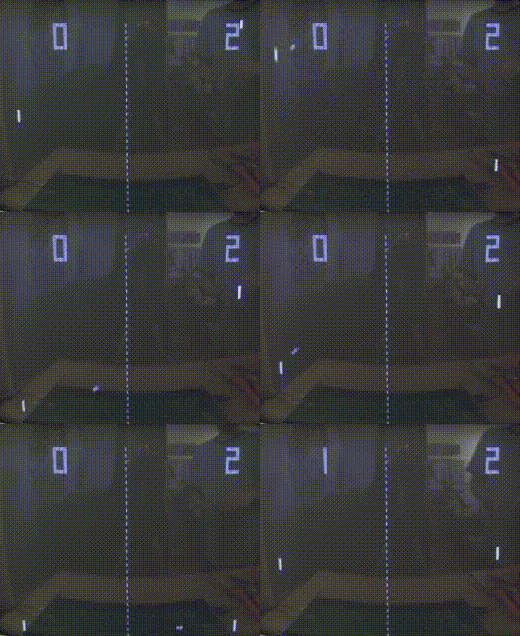
- All of a sudden, the group had a worldwide sensation on their hands. As a home console game, it lacked the depth and longevity to be rewarding, but in the arcades, it had a kind of mass appeal which could attract players and get them hooked on the game immediately- an ideal incarnation of the “easy to learn, difficult to master” philosophy.
Built on hardware that smashed an arcade game together with Spacewar, using gameplay from the Odyssey, Pong was not the first video game by any definition.
But then again, in the collective minds of the wider world, it certainly was. It was the first video game that people perceived to be a video game. Not all of the precursors to Pong resemble each other, but they all resemble Pong, and without Pong, we would not perceive them to be video games at all. It didn't take long for more video games to follow.